
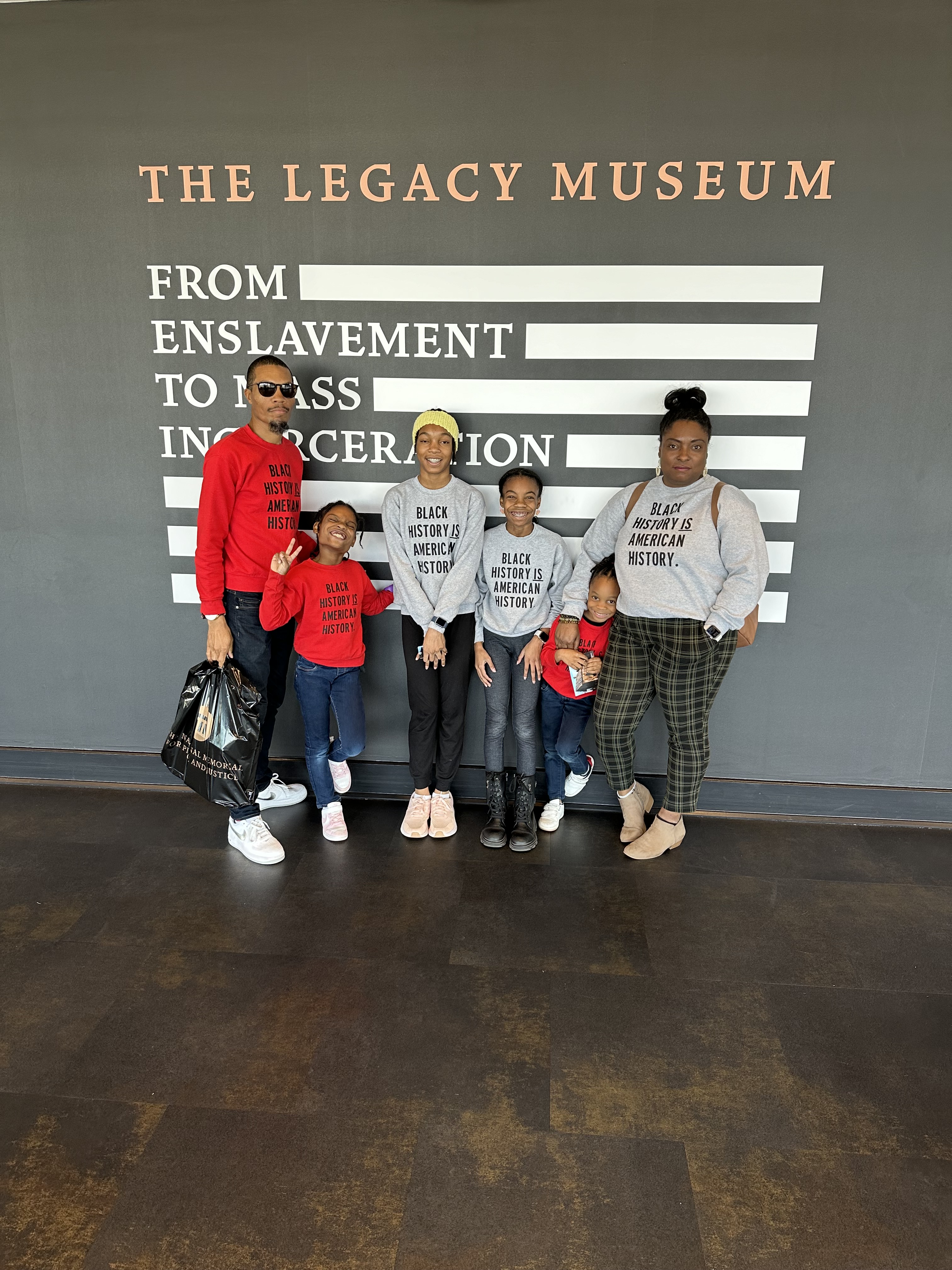
It was unpleasant for me, acknowledged Olivia our second oldest daughter (age 11). She’s also our empath and so she feels everything deeply. Listening to the stories of wrongly incarcerated people or seeing the slave market ads or really any of the content likely brought up a lot of feelings.
When I did the research about the museum, I saw one review that said it was such a moving experience, no one will leave without shedding a tear. I wanted to experience that. Even though it was hard to witness, I’m glad we went. I feel like I grew. This came from Riley, our eldest (age 13) who also planned the day trip. She choose our destinations, and apparently she had intention behind her choices.
Our youngest two daughters, ages 5 and 8 had their own mixed reviews. London, the 8 year old is sensitive to any kind of imagery that will give her nightmares. Guess who didn’t sleep much last night? Meanwhile, Sloane our 5 year old who often says things years beyond her age revealing a deep wisdom from a soul who seems to have been here before reflected, if I’m being real (what???), I was scared too, but then I realized that I have my friends and family with me and that made me not scared anymore. She also has a strong fascination with all things dark and mysterious so parts of the museum that probably would have scared other young kids, she was curious about. Samantha basically had to drag her out of the middle passage section of the museum because she was so intrigued by the depiction of the lost African souls on the voyage across the Atlantic.
Hours after our day trip to Montgomery to visit the new Legacy Museum created by Brian Stevenson and the Equal Justice Initiative, we were still unpacking its impact on us. As you can tell, it was a lot to take in, and even more to process. Riley planned a good trip, she wanted to mix up some of the heavy stuff with lighthearted fun as well. Unfortunately our trip to the waterfront was cut short due to flooding, but we still had a great time walking around downtown Montgomery and eating at Dreamland BBQ. For a day trip that only took 8 hours total (including drive time there and back), we packed a lot of learning into our 9 to 5 this MLK day. What came out of it were conversations that I’m sure will reverberate throughout their lives.
Let’s start with the obvious: it’s not easy visiting museums in the first place with young kids. They’re fidgety and ask lots of questions. Or they don’t pay attention to the things you want them too. Or they pay attention to things you’d never expect and you have to figure out explanations for later. It’s a delicate balancing act as a Black parent taking your kids to a museum, particularly one that depicts the history of race and racism in our country. On the one hand, I feel a sense of responsibility to ensure that my daughters understand the full context of our history. The reason why museums exist in the first place is to memorialize aspects of our collective consciousness, to ensure that parts of our stories don’t go untold. The danger is we will forget to tell our full stories about who we are and where we’ve been, and thus never really find our way forward together.
I ended up having a longer, deeper conversation with the older two last night. Sitting on the edge of her bed, Olivia shared a struggle she had after seeing some of the content at the museum yesterday, she asked the question that we’ve heard before… clearly this kind of treatment was unfair, by why did they do it? Why would people behave like this? I don’t have a good answer for that question, and I suspect I never will. But what I do know is that we don’t have the option of forgetting. I reminded them that much of what they learned about, from the brutality of slavery, to the failure of reconstruction, and the continued systemic racism still has impact today, particularly in the advantages that have built up over time and the disadvantages that people of color continue to face, particularly Black folks.
This led to an interesting conversation about whether some of their non-Black friends are having these same kinds of experiences. One daughter wondered aloud, would any of her non-Black friends even want to come to a museum like this? Would she want to invite them? Honestly I don’t know, but I hope so. I hope that all parents are taking it upon themselves to have conversations about who we are as a people and how we got here.
I believe there’s this false assumption that perhaps because we engage in difficult conversations about race more frequently, that it’s any easier for us. It’s not. I admitted that this isn’t particularly easy for me either to the girls. Do you think I like talking about difficult things, or experiencing hurt and anger at what happened to people who look like me? Do you think I like connecting the dots between the injustices my parents, grandparents, great-grandparents who I grew up with and learned the lessons of their own hardships through their stories of segregation, integration, and continued racism? I don’t, and yet it’s not really an option for me to simply ignore it or say, well that was in the past we should move forward.
One of my favorite authors, Austin Channing Brown writes:
Our only chance at dismantling racial injustice is being more curious about its origins than we are worried about our comfort. It’s not a comfortable conversation for any of us. It is risky and messy. It is haunting work to recall the sins of our past. But is this not the work we have been called to anyway? Is this not the work of the Holy Spirit to illuminate truth and inspire transformation? It’s haunting. But it’s also holy.
I would have loved to see more non-Black visitors yesterday at the museum, particularly non-Black families. But instead, I saw a ton of Black families who had the same idea that we had: this is our opportunity and even our patriotic duty to ensure that our kids understand the full story. We’re raising young citizens who will be the future, and we all know what happens when a people decide to forget their past: they’re doomed to repeat it. One other bonus that I loved from yesterday, I saw a large contingent of uniformed military men and women. I’m not sure what that was about, but growing up in a military family myself, it was nice to see them in this place.
One final thought for those who choose to visit the Legacy Museum as we did: spend more time in the final room (the one with the big gold ceiling). There must have been hundreds of Black luminaries and their stories on the walls and coming at the end of the journey through our history in this country, it was a good opportunity to end on an uplifting note. We should have spent more time there. As we realized later in our debrief it’s easy to get caught up in the trap of thinking that our experience starts with slavery, or that all of our experiences have been bad and that’s just not true. We are a resilient people with a history that predates our time in this country (as my daughter Riley reminded me herself… we’re doing something right with that one!).
I went to bed last night a proud father. I was proud of my older girls for leaning into growth and proud of us for doing hard things. I was also a little worried if I’m being honest. Not about the littles and their nightmares, that’ll pass. But more worried about what will happen if this conversation isn’t taken up by more and more families. This can’t be on us. Museums can be difficult reminders of our past, but they don’t have to be the traumatic experiences if we learn to face them and process them together. That’s why we still go. I was also hopeful. If my daughter can decide to explore this and bring us along, who’s to say that this can’t spread among other young people?
SDW3

 everyday fatherhood