What should I do next?
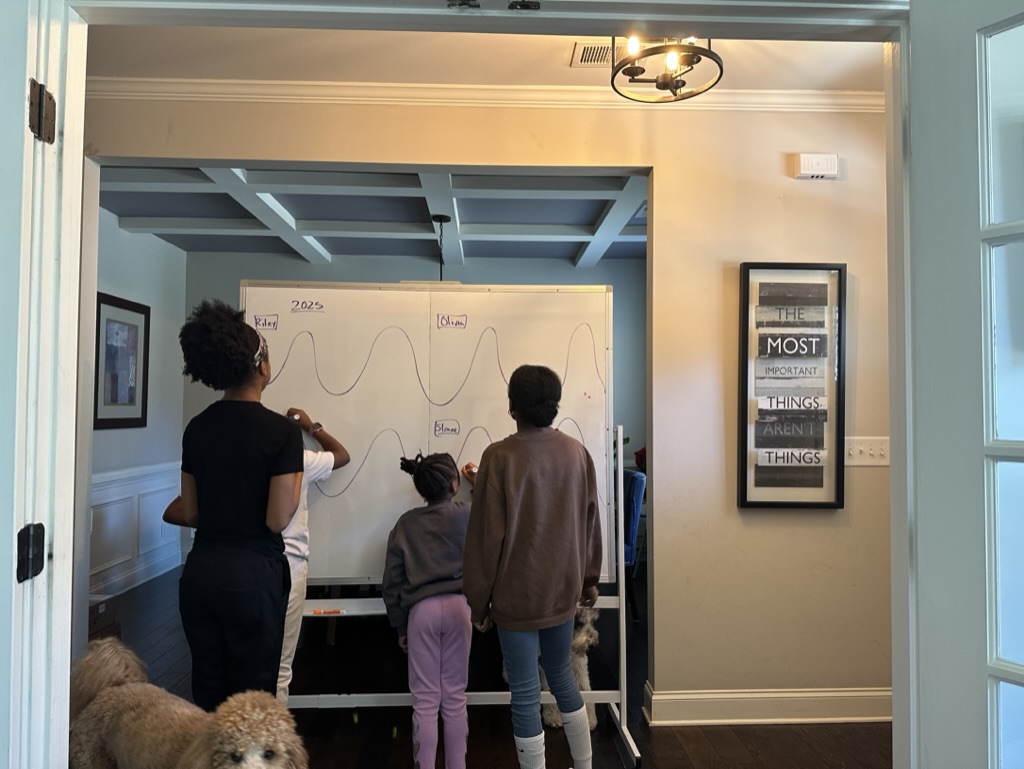
That’s the question my daughter wrote on the board during our annual family ritual of reflecting on the past year and setting intentions for the next one. I couldn’t shake it. Not just her asking it, but the question itself. So later that day, while driving to the recycling center, just the two of us, I asked her to tell me more about what was behind it.
For context: this is my oldest daughter, a sophomore in high school, blessed and burdened, with the classic responsibility gene that comes with being the oldest of four girls. She’s also one of the most thoughtful teenagers I know. When she speaks, it’s usually the result of real deliberation, not just a passing thought.
She began by sharing that she’s not sure that her current school is preparing her for what she wants to do next, and for her that’s college on route to a career as a wildlife veterinarian. This came as a bit of a shock to me because my wife and I have gone through great lengths to provide the girls with what we believe is the best educational environment for them. Besides, I’m not just her dad, I’m also an educator. I technically know what’s better for her, right? Curious and surprised, I decide to listen further to gain clues as to where this newfound revelation is coming from.
She explained that the self-directed nature of her school has left her unsure whether she actually knows how to study. She worries she might be behind her peers because there aren’t grades or tests to measure where she stands. It’s a very Type A dilemma: Give me the rules. Give me the bar. I’ll clear it. Just tell me what to do. On the other hand, she likes the freedom she’s had over the past few years to explore her interests and go at her own pace.
As she talked, I realized she was challenging some deeply held beliefs of mine, so I named my bias upfront. Two decades in education as a teacher, policy maker, board member, and for a brief time school leader, has confirmed for me that the way we “do school” just doesn’t work for most people. School for the majority of people is mostly about compliance, sorting, and tracking. Learn how to get the grade, pass the test, and move on to the next thing. It’s a game that some people get good at playing (my hand is raised), but others never buy into.
To make my point, I turned to an example from her own life. Over the past few years she’s taken up crocheting as a hobby. She learned it first from watching her Aunt, and then she became self-taught as she read books and increased her practice. Over time, she became an expert, so much so that she’s sold her work at business fairs and taught others how to crochet.
I asked her, how did you learn?
She said it was simple: she wanted to and she started reading and practicing a lot.
Then I asked, If you had to take a test on crocheting right now, do you think you’d pass?
She, paused and thought about it before saying yes—probably. Not sure she’d get an A, but she’d pass. Hmm…
So I asked one more question: What proves you know how to crochet more—the test, or the fact that people buy what you make and you’ve taught others to do it?
She readily agreed, it was the fact that she could create cool items and teach others to crochet that served as better evidence of mastery.
I used crocheting as an example, but I could have easily used biology or algebra and given her examples of ways that her self-directed study has led to far deeper learning than any traditional course of study would. But, the point wasn’t to prove her wrong, it was to listen and then offer an alternative to consider. She might be right after all. That realization shifted the conversation, and I asked her what else she hoped to get out of her high school experience that she believes will prepare her for what comes next.
One firmly held belief that I have as both a parent and an educator is that every child is unique and needs their own path. It just might be that my daughter is ready to “play the game” for her own purposes to get to where she wants to be next. It’s also possible that some of my resistance to traditional schooling comes from my own past experiences—my own educational trauma (something hard for most parents to admit).
What I do know is that I’m proud of her for asking the question, what’s next? It can be challenging and even scary to face the unknown of transitions. I’m not sure what the answer is yet, but I am confident that together we’ll figure it out. It all starts with asking the right questions.
SDW3
 everyday fatherhood