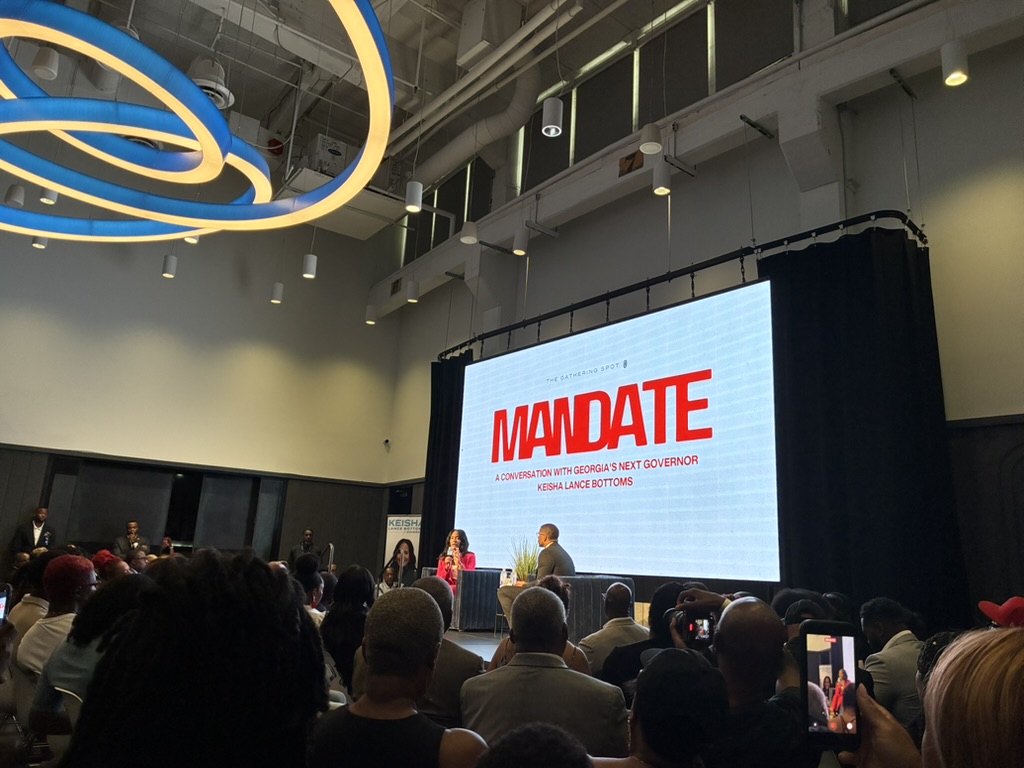
Yesterday I did a thing. I went on a man date with another dad friend. Here’s how it happened.
I got an email late Sunday afternoon from the founder of my favorite Black co-working hub, The Gathering Spot. Ryan Wilson sent out an all call to Black men, with a mandate: let’s talk about our support for Black women, and in particular Georgia gubernatorial candidate Keisha Lance Bottoms.
There’s been a lot made lately about Black men’s drifting support away from progressive candidates, and in particular their lack of support for Kamala Harris, another Black woman in the last presidential election. Everyone from Politico to Pew and NPR has chronicled what they think happened and why. And now people are wondering if that same narrative carries into the 2026 midterms.
Now, despite the fact that Black men, (just like Black voters in general) aren’t a monolith, we’re allowed to have a diversity of opinion and thought, the vast majority of Black men did support Kamala (75% according to Pew). It just still wasn’t enough to quiet the narrative that Black men didn’t show up for this particular Black woman. For those who didn’t, who either choose the couch or Trump, the question is: was this an environmental, structural, or message problem?
Here’s what I mean. Going into the 2024 election, the political environment was already going to be difficult, regardless of the candidate. Inflation was high and people were struggling with the early days of the affordability crisis. Structurally, on top of all of that, you had an unprecedented change in candidate at the top of the ticket, with only 107 days to go until the election. To do what she did, with the structural disadvantages of time working against her is an impressive feat itself. Finally, it has to be asked, what, was her message to Black men in particular? It was clear that Trump was reaching out to young male voters, harnessing the power of the manosphere through podcasts and whatnot to reach a group of voters who don’t tend to vote all that regularly. And to his credit (or shenanigans), he managed to convince them that he had their best interest at heart.
Again, though Black men aren’t a monolith, at least among my group of friends we tend to care about similar issues. Many of us are fathers, husbands, and partners, so we care about providing for our families and giving our kids more than we had. We talk about hopes and dreams, and for a lot of us, that also includes our fears with our sons and daughters growing up to face some of the same harsh realities we’ve faced. Every police shooting of an unarmed Black kid brings the same conversation about law enforcement back to the surface. Every time one of us hits a long-held goal, we celebrate hard, because the wins are that much sweeter.
So when the invitation landed in my inbox, I jumped at it, and I invited one of my friends to come along. Actually, I pre-registered him and then called him and told him he was already on the list. Fortunately, he was good to go along with my little adventure. We talked at 3pm, and 2 hours later we were in the car driving to the Gathering Spot.
I knew we’d have a little wait when we pulled up and saw the television crew and parking lot beginning to fill up. While we waited, we debated what she might say and what we might ask. We also talked about how many of our own previous conversations, at the barbershop and other places were precursors to this evening. As we entered into the room, I started to see the crowd take shape. The room was definitely mostly men, but still maybe about a third of it was Black women as well.
I wondered how that might change the dynamics of the conversation. It’s one thing to have a family conversation, for example after hooping with a few other guys or at the barber shop. Folks have less of a filter in these settings (which can be a good or bad thing), but at least we’re having a real conversation. Full disclosure: I’m not always proud of everything said in those rooms. I’m just grateful for the room. I remember when my girls were little I would bring them with me to the barber shop and while it was definitely educational for them, sometimes it got a little hairy.
As it turned out, the conversation went pretty much as I expected for a political event, albeit one hosted at a Black spot, by and for mostly Black men. I was proud that my question got almost right off the bat. I asked, what do you say to the Black men who you’re concerned may not turn out for you in large enough numbers like with Kamala? (or some version of that question). Her response (I’m paraphrasing): I can’t speak on why they didn’t vote another candidate, but what I can say is that here’s what I support and here’s why they should vote for me. She then went on to talk about her platform around affordability, healthcare expansion, support for small businesses, etc. All the right things, even if it sidestepped the elephant in the room.
But she had plenty that landed with me, across every identity I carry, as a father, husband, Black man, etc. When asked about what she believes Black men care about, she talked about listening to her husband and older her voting age sons. They talk about jobs, public safety, affording a home, and mental health. She addressed the narrative that Black men are less engaged and offered up this rebuttal for singling out Black men’s support: it’s an unfair burden for Black men to carry, this democracy is about all of us, we should all be engaged. And when her record came under attack, she showed up with receipts, like every Black woman I know always does.
She had a few great one-liners too: if you can be bought, you can be sold. When asked how people can get involved, she advised, put your own oxygen mask on first. Take care of what you need to take care of and start with what’s accessible for you. Some people, the most they can do is show up to vote. For others, it’s voting, volunteering, donating, etc. And to the argument that a Black woman can’t win statewide in Georgia, she pointed out it already happened last year, in our statewide PSC race. So she reminded us all that we should expect to win.
My favorite thing that she said though all evening was, her closing message. She said, I want us all of us to win, that’s why I’m in this race. This resonated with me because of what I know about the Black women in my own life, they really do want us all to win. Even if it means sacrificing themselves. And that’s why our support matters so much in this moment. That’s why I wanted to be in the room for last night’s conversation. And it’s why I’m excited to carry the conversation forward.
I still have a photo of our family watching the inauguration of President Biden and Vice President Harris. Getting to witness the historic occasion with my girls was an important milestone in our lives. I think it matters that they know who I support and why. And in particular, I think it matters that they know why I support the Black women who always have our back.
SDW3

